Unlocking Motivation: The PINCH Method for Neurodivergent Learners
- Dominique Marinello
- Oct 16, 2025
- 2 min read
Motivation can be tricky—especially for neurodivergent students who may struggle to get started or stay engaged with certain tasks. But motivation isn’t about “trying harder.” It’s about understanding what lights a spark and how to harness it in ways that work for each learner.
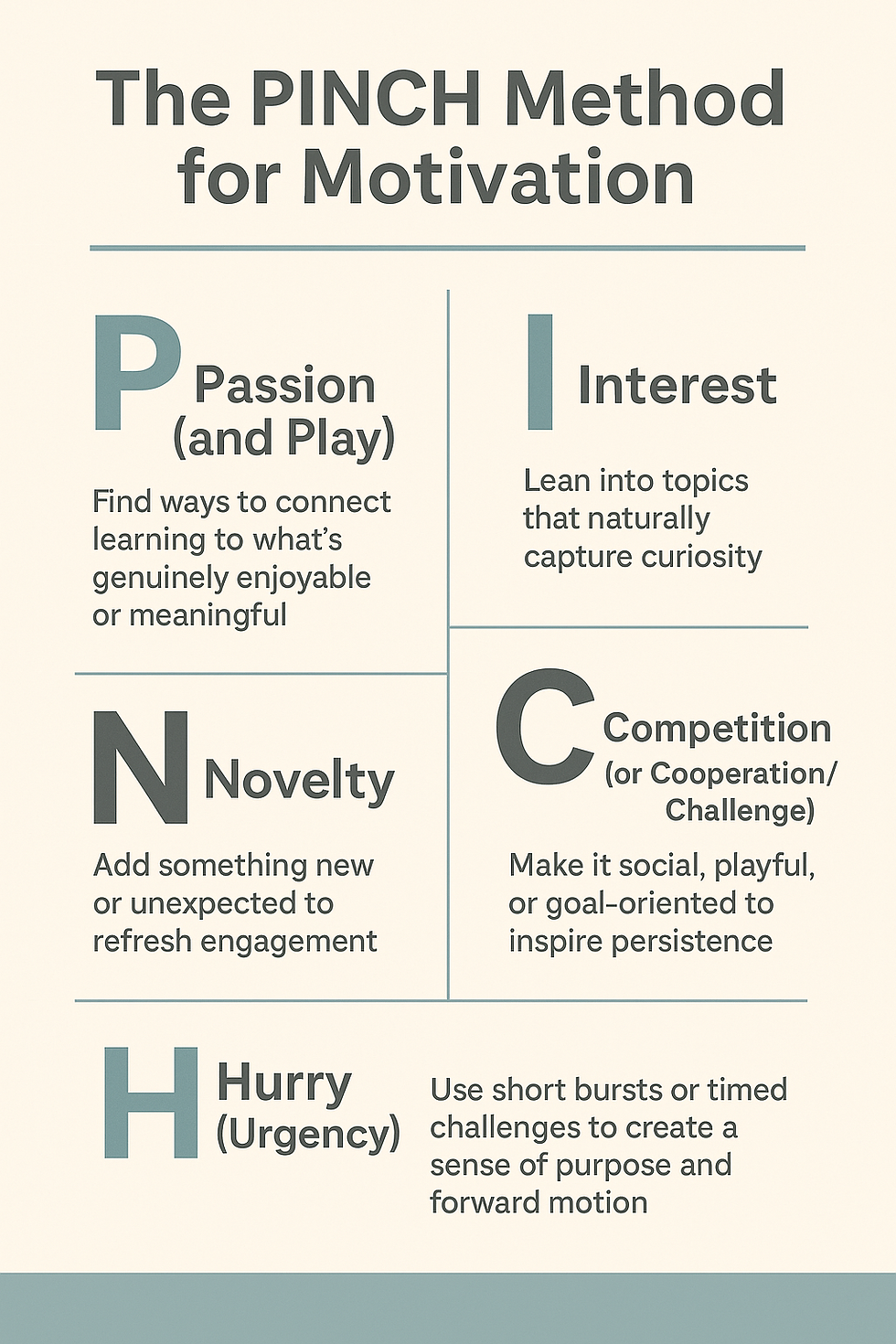
That’s where the PINCH Method (developed by Dr. William Dodson) comes in—a simple, powerful framework for tapping into what drives a student’s focus and effort:
P — Passion (and Play): Find ways to connect learning to what’s genuinely enjoyable or meaningful.
If a student loves animals, use that interest to teach other skills—reading animal articles for comprehension, or using animal-themed math problems. Adding an element of play helps students stay engaged and joyful while learning.
I — Interest: Lean into topics that naturally capture curiosity.
A child fascinated by space might write a journal entry as an astronaut or calculate distances between planets in math. Building on genuine interests makes learning feel purposeful rather than forced.
N — Novelty: Add something new or unexpected to refresh engagement.
Introduce a new learning tool, change up the workspace, or add a visual twist—like using colorful sticky notes or a “mystery box” of surprise challenges—to make familiar work feel exciting again.
C — Competition (or Cooperation/Challenge): Make it social, playful, or goal-oriented to inspire persistence.
Turn a task into a fun challenge—like “beat the clock,” “see how many you can get right in two minutes,” or “work together to earn points.”
H — Hurry (Urgency): Use short bursts or timed challenges to create a sense of purpose and forward motion.
Try brief, time-bound goals such as “Let’s see how much you can finish before the song ends” or “You have five minutes for this round.” Creating gentle urgency can spark momentum and focus.
How Reimagine Education Helps
At Reimagine Education, we work with students who have learning differences, ADHD, or executive functioning challenges to help them build motivation, confidence, and independent learning skills. Using research-based approaches like the PINCH Method, educational therapy becomes more than just academic support—it’s a way to help students reimagine what they’re capable of.
If your child could use support unlocking their motivation, call today to learn more about how educational therapy can help.
✨ To learn more about how Reimagine Education in San Diego supports neurodivergent learners with executive functioning and motivation strategies, contact me here.